Skip to content

13 April, 2026

  • Saved Articles
  • My Account
  • Subscribe
  • Log In
  • Log Out

Board Agenda

  • Governance
  • Strategy
  • Risk
  • Ethics
  • News
  • Insight
    • Categories

      • View all
      • Governance
      • Strategy
      • Risk
      • Ethics
      • Board expertise
      • Finance
      • Technology
    • AI agents

      The AI risk faced by every board right now

      Even if no one in the organisation planned their arrival, AI agents are already present...

      sustainability litigation

      Is your board at risk of sustainability litigation?

      ESG disclosures, until recently focused on reputational risk and stakeholder expectations, are now becoming legal...

      sustainability Asia

      Navigating sustainability in Asia

      Boards operating across regions need to leave aside assumptions and consider the impact of a...

  • Comment
      • View all
    • AI agents

      The AI risk faced by every board right now

      Even if no one in the organisation planned their arrival, AI agents are already present...

      sustainability litigation

      Is your board at risk of sustainability litigation?

      ESG disclosures, until recently focused on reputational risk and stakeholder expectations, are now becoming legal...

      investor confidence

      Lack of audit reform ‘will hit investor confidence’

      Government's failure to push ahead with audit reform is a risk to UK investments, the...

  • Interviews
      • View All Interviews
      • Podcasts
      • Webinars
    • future-ready

      Is your board ‘future-ready’?

      The survival of a business in uncertain times depends on its ability to pivot as...

      investor confidence

      Lack of audit reform ‘will hit investor confidence’

      Government's failure to push ahead with audit reform is a risk to UK investments, the...

      stewarding AI

      AI is a ‘special case for governance’

      As AI use in the boardroom grows, it’s essential to focus on the ethical and...

  • Board Careers
      • View All
    • female CEO

      Number of women in leadership stays unchanged

      In 2021, there were only eight female CEOs in the FTSE 100—a figure that is...

      female NED

      UK female non-executives earn £73k less than male NEDs

      Although the UK’s average gender pay gap on boards is shrinking, it is still one...

      directors duties

      3 top tips on directors’ duties

      When directors fall short of their responsibilities, the consequences can be devastating. How can board...

  • Resource Centre
      • White Paper Downloads
      • Book Reviews
      • Board Advisory & Corporate Services
    • FRC audit approach cover march 2026

      An evolved audit supervision approach 2026

      The Financial Reporting Council outlines its revised approach to audit supervision, which focuses on firms’...

      Protiviti 2026 governance AI

      The Board’s AI Moment, 2026

      This report, from Protiviti’s 2026 Global Board Governance Survey results, focuses on artificial intelligence.

      HEIDRICK GOVERNANCE 2026

      Governing Under High Uncertainty: Opportunities for Emerging-Market Boards

      This report from Boston Consulting Group, Heidrick & Struggles and INSEAD examines how boards are...

  • Events
  • Search by topic
    • Governance
    • Strategy
    • Risk
    • Ethics
    • Regulation
    • ESG
    • Investor Relations
    • Careers
    • Board Expertise
    • finance
    • Technology

FRC is ‘working on a UK version of Sarbanes–Oxley’

by Gavin Hinks on December 16, 2019

One of the Kingman review’s key recommendations for reforming audit was a version of US Sarbox rules, a proposal supported by many audit committee chairs.

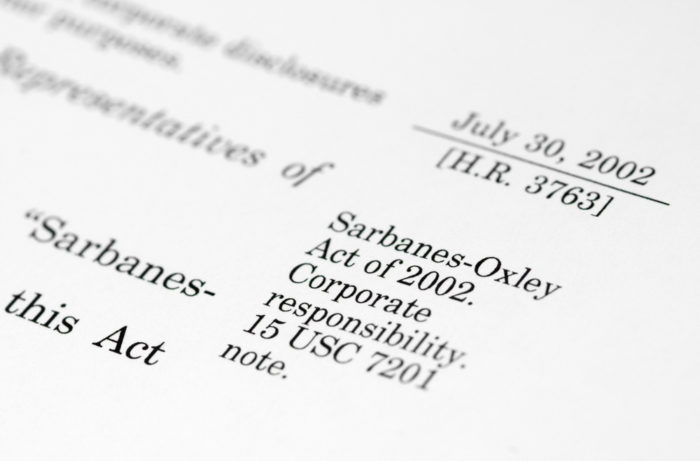
Sarbanes–Oxley, Sarbox

Image: Ellen McKnight/Shutterstock

Favorite

In 2002, in the wake of the Enron and WorldCom scandals, US lawmakers introduced stringent rules handing chief executives and finance directors legal responsibility for internal controls and better reporting.

Following the UK’s general election last week, speculation is now rife that Britain is about to take a similar course.

Last year and the year before, the UK agonised over audit, auditors and audit regulation. This week newspapers, notably The Sunday Times and City AM, report that the Financial Reporting Council (FRC) is working on a version of the Sarbanes-Oxley Act (Sarbox) to be introduced by the new government.

This should not take us by surprise. A version of Sarbox, or at least reviewing the possibility of introducing such a law, figured among the key recommendations for reforming audit and governance regulation published in December 2018 by Sir John Kingman. Nor should it be an enormous surprise that that the FRC is working on draft rules. The FRC has been quietly working on transforming itself in the background despite politicians being hugely distracted by Brexit.

For their part, the FRC will only confirm that Sir John recommended a new internal controls regime and that the Department for Business, Energy and Industrial Strategy (BEIS) was broadly in support of the Kingman report.

However, it would be a surprise if the FRC is pushing ahead with proposed law without preparing for detailed consultation first.

Sir John said BEIS should “give serious consideration to the case for a strengthened framework around internal controls in the UK”. Lessons, Sir John added, should be learned from the operation of Sarbox, the pros and cons analysed and then presented for consultation.

Support for Sarbox

Many UK companies are familiar with Sarbox as a result of running US operations that fall under its ambit. Sir John found himself surprised by the support he found for a Sarbox-style regime.

Sarbox imposes requirements for chief executives and chief financial officers to report annually on the effectiveness of a company’s internal controls over financial reporting. Auditors must also “attest to, and report on, management’s assessment of its internal controls”.

At the time, Sarbox was viewed as a major upheaval with implications far and wide, after lawmakers said it should be applied even to foreign-owned US-listed companies.

Sir John wrote that his review members were “particularly struck” by the support for Sarbox-like rules among audit committee chairs.

“The arrangement is seen as having led to better financial reporting, fewer significant accounting restatements and stronger reassurances for audit committee members about the robustness of internal controls.”

His report added: “The provisions also underline clearly that the primary responsibility for internal financial controls and the accuracy of financial reporting rests with the board and management of a company.”

‘Significant costs’

While Sir John was keen on looking at the possibility of Sarbox rules he also conceded problems. It would be a “very major step” with “significant costs” at the beginning, particularly for smaller listed companies which, in the US experience, are “affected disproportionately”. Listing, Sir John said, could become less attractive as a result. And this at a time when many observers are concerned about the number of companies coming to market.

Earlier this year, Tom Kloet, chair of the audit committee at Nasdaq, told the Chartered Governance Institute in an interview that Sarbox “overall” has had “material benefits”. Though many of the reasons are due to factors already in place in the UK: it guaranteed independent directors on audit committees and the creation of a new audit regulator (the Public Company Accounting Oversight Board). But he also said compliance had become more expensive and that had possibly affected the decision of some companies to go public.

Both the Kingman Review and a review by the Competition and Markets Authority have made extensive recommendations for reform of audit. Another review looking at the contents of audits, led by Sir Donald Brydon, is due to report on 13 January.

Sir John publicly complained earlier this year that government had done nothing to introduce the powers necessary for a reformed audit and financial reporting regulator.

Now that a general election is out of the way and the country’s Brexit destiny more or less resolved, political attention may turn back to more mundane issues. Audit and financial reporting are on the agenda and boards should be prepared for the possibility of significant change.

  • Facebook
  • Twitter
  • Google+
  • LinkedIn
  • Mail

Related Posts

  • Queen's Speech fails to provide clarity on audit reform plans
    May 11, 2022
    Prince Charles reads the Queen's Speech on 10 May 2022.

    While the creation of ARGA is confirmed, details about other proposed changes are scant and uncertainty over timing remains.

  • Campaigners urge FRC to name and shame failing audits
    October 5, 2021
    Businessman looking at audit figures

    Transparency groups including Greenpeace UK say failing to disclose the audits involved "risks creating a general lack of confidence in all audit opinions".

  • FRC unveils new audit committee standards
    November 10, 2022
    audit committee standards

    Watchdog’s guidance to audit committees aims at expanding choice and addressing competition within the audit market.

  • Audit reform consultation set to close as dissenting voices emerge
    July 6, 2021
    Auditor signing an audit document

    Lack of ownership reform and plans to extend the definition of “public interest entity" have drawn criticism from prominent figures.

Search


Follow Us

Most Popular

Featured Resources

wef global risks 2025

The Global Risks Report 2025

The 20th edition of the Global Risks Report reveals an increasingly fractured global...
Supply chain management cover

Strategic Oversight in Supply Chain Management: A Guide for Corporate Boards 2025

Supply chains have become complex, interdependent and opaque and—according to research...
OB-Cyber-Security

Cyber Security: What Boards Need to Know

Maintaining firewalls, protecting servers and filtering malicious emails rarely make...

C-suite barometer: outlook 2025 - UK insights

Forvis Mazars draws UK insights from its global study and looks at UK executives’...

The IA’S Principles Of Remuneration 2024 2025

This guidance from the Investment Association is aimed at assisting remuneration...
Diligent 2024 leadership tech cover

Leadership, decision-making & the role of technology: Business survey 2024

This research report by Board Agenda and Diligent sheds light on how board directors...

Director Reference Guide: Navigating Conflict in the Boardroom

The 'Director Reference Guide' on navigating conflict in the boardroom provides practical...
Nasdaq 2024 governance report cover

Nasdaq 2024 Global Governance Pulse

This Nasdaq survey gathered data from more than 870 board members, executives, and...

Becoming a non-executive director (4th edition)

Board composition is the subject of much debate, while the role of the non-executive...
art & science brainloop new cover

The Art & Science of Creating an Effective Board

Boards are coming under more scrutiny and pressure than ever before from regulators,...
SAA First time NED guide

First Time Guide for Non-Executive Directors

The role of the non-executive director has never been more vital: to advise, support,...

SUBSCRIBE TODAY

Stay current with a wide-ranging source of governance news and intelligence and apply the latest thinking to your boardroom challenges. Subscribe


  • Editors & Contributors
  • Editorial Advisory Board
  • Board Advisory & Corporate Services
  • Media Marketing Solutions
  • Contact Us
  • About Us
  • Board Director Network
  • Terms & Conditions
  • Privacy Policy
  • Cookies

Copyright © 2026 Questor Media Group Ltd.

  • Terms & Conditions
  • Privacy Policy