
Skip to content

7 September, 2026

  • Saved Articles
  • My Account
  • Subscribe
  • Log In
  • Log Out

Board Agenda

  • Governance
  • Strategy
  • Risk
  • Ethics
  • News
  • Insight
    • Categories

      • View all
      • Governance
      • Strategy
      • Risk
      • Ethics
      • Board expertise
      • Finance
      • Technology
    • data

      Every board needs a scientist or engineer

      STEM professionals are trained to work with incomplete data, and in business you rarely have...

      climate risk

      Now is the time to take action on climate risk

      Whatever direction national policies take, nature and climate remain as drivers of value and risk...

      AI risk

      AI is about strategy, not technology

      Clients are judging how professional services firms are performing against their AI expectations, but most...

  • Comment
      • View all
    • data

      Every board needs a scientist or engineer

      STEM professionals are trained to work with incomplete data, and in business you rarely have...

      climate risk

      Now is the time to take action on climate risk

      Whatever direction national policies take, nature and climate remain as drivers of value and risk...

      ai skills gap

      Don’t forget to price up the AI skills gap 

      With AI set to be biggest force reshaping organisations, it is time to put workforce...

  • Interviews
      • View All Interviews
      • Podcasts
      • Webinars
    • governance

      How better governance helps private companies grow

      If governance is to become mature, management decision-making has no place on the board’s agenda,...

      future-ready

      Is your board ‘future-ready’?

      The survival of a business in uncertain times depends on its ability to pivot as...

      investor confidence

      Lack of audit reform ‘will hit investor confidence’

      Government's failure to push ahead with audit reform is a risk to UK investments, the...

  • Board Careers
      • View All
    • board skills clash

      When board skills clash

      Board composition in terms of expertise has a clear impact on entrepreneurial decision-making and strategy,...

      female ceos

      FTSE 100 CEO appointments rise

      The number of CEO appointments has doubled in six months, although the global picture suggests...

      board role

      How to engage with outreach

      When board opportunities knock, should you answer the door? Here are tips from a new...

  • Resource Centre
      • White Paper Downloads
      • Book Reviews
      • Board Advisory & Corporate Services
    • Georgeson 2026 European AGM Season Review

      Georgeson’s deep dive into the evolving dynamics of investor voting across nine major European markets in...

      2026 MidYear Executive Benchmark Survey: The Verification Gap

      AI enthusiasm is running into reality: 1 in 4 executives in this Workiva survey say...

      Seven Steps for Futureproofing Business

      This guide from Business in the Community aims to help businesses build a practical strategy...

  • Events
  • Search by topic
    • Governance
    • Strategy
    • Risk
    • Ethics
    • Regulation
    • ESG
    • Investor Relations
    • Careers
    • Board Expertise
    • finance
    • Technology

Business looks to automation in the wake of Covid-19

by Kamal Bechkoum

Robotics and automation will become more important than ever as a solution for UK business recovery amid the pandemic’s devastating economic impact.

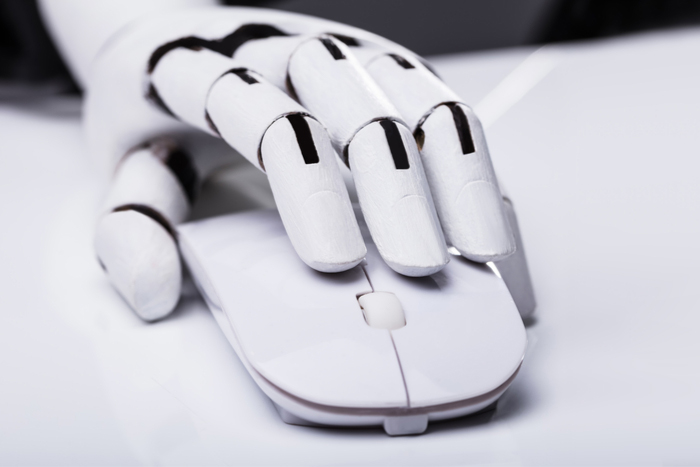
robotic hand on mouse

Image: Andrey Popov/Shutterstock

Favorite

At the end of February, before Covid-19 had begun its domination of our daily lives, the University of Gloucestershire’s School of Business and Technology hosted a special event dedicated to the engineering and technology sectors.

Amongst the many displays, presentations and networking sessions, one particular subject stood out which I believe will become more important than ever in offering a solution for UK business recovery during and beyond the pandemic’s devastating economic impact—robotics and automation.

Automation technologies company ABB showcased some of its latest innovations at the event. It also offered some statistics about how they see automation as being designed not to “steal” jobs, but to benefit organisations by supplementing high-volume and repetitive work that frees up valuable time for more challenging tasks.

We need to work smarter to produce more with existing resources. This means introducing better computing and engineering solutions using robotics and automation

While a robot engineer on display called “Yumi” showcased its dexterity, speed and programmable accuracy, constructing a small box and packing it with select items, ABB’s Julian Ware described the opportunities that automation solutions herald for businesses both small and large.

“There currently aren’t enough robots in the UK. As a nation we’re one of the top ten when it comes to manufacturing output and our exports are sold across the world. However, productivity is surprisingly low compared to other countries,” he explained.

“In the UK GDP per hour worked is lower now than it was in 2007, despite employment being higher. In 2016 output per hour in the UK was 22.6% below the US; 25.6% below Germany, and 26.2% below France.”

Considering how these figures are being further decimated by the impact of Covid-19, we need to work smarter to produce more with existing resources. This means introducing better computing and engineering solutions using robotics and automation.

Greater automation doesn’t mean fewer humans

By training and reskilling employees, organisations can prepare their people to work with automated processes and alongside machines.

Most workers would rather be removed from work which is boring, dirty and repetitive and be provided with more fulfilling roles

As companies come under greater pressure with Covid-19, the biggest immediate impacts of automation are likely to be seen in sectors such as insurance, financial services and human resources, where algorithms offer faster and more efficient assessment. In the longer-term, robots are likely to be added into manufacturing and services where measurement and analysis are vital to keeping operations running smoothly.

Robots are now being used to help maintain the social distancing of some hospital staff and patients, as well as alleviating the workloads of nurses and doctors. The growth in robotics usage has been so sudden and widespread it is believed the industry will be worth more than $23bn by 2021.

Most workers would rather be removed from work which is boring, dirty and repetitive and be provided with more fulfilling roles, enabling them to add greater value and deliver better quality products and services. Just look at the current shortage of fruit and vegetable pickers in the UK at a time of crisis, when innovative automation could be saving millions of pounds of otherwise wasted crops.

Is Covid-19 increasing demand for automation?

Covid-19 is already changing the way consumers behave and expanding opportunities for automation. Companies of all sizes are reviewing how they use robots to increase social distancing and reduce the number of staff that have to physically come to work.

In Milton Keynes, a fleet of robots on wheels that deliver shopping have seen their popularity surge as residents are locked down at home.

Companies of all sizes are reviewing how they use robots to increase social distancing and reduce the number of staff that have to physically come to work

In Japan, workers at a warehouse in Sugito that processes millions of personal care products each day were overrun by a spike in demand for masks, gloves, soap and hand sanitiser, and are using more robots to pick objects from bins and assemble orders.

In Texas, the Westin Houston Medical Center hotel is using hospital-grade robots to emit intense light using pulsed xenon to kill pathogens after being wheeled in by housekeeping staff.

Employees and clients alike now care more about their safety, and moves towards automation will keep them all healthier. Ultimately customers will reward companies that successfully do this.

The government’s current estimates are that for the engineering sector to gain enough candidates to reduce skills shortages, they would need around 186,000 skilled recruits each year until 2024. This will undoubtedly be true even after the impact of Covid-19 has been fully understood.

The UK is one of the world’s best countries to become an engineer. Not only are university graduates likely to be earning up to 20% more than their counterparts in other subjects, they can also find themselves working in areas such as industrial systems or the Internet of Things. Their expertise is often employed in fast-paced technology and developing products matching rapidly evolving consumer demands.

Yes, engineering can be complex, but it stands to reason that everyone benefits if industry and educators work together to catch the attention of a wide range of young, new recruits, not just those who are already deemed to be “technical”. With demand for industry rapidly capabilities rapidly increasing, it is encouraging to have something positive to look forward to.

Professor Kamal Bechkoum is head of business and technology at the University of Gloucestershire.

  • Facebook
  • Twitter
  • Google+
  • LinkedIn
  • Mail

Related Posts

  • Identity crisis: the threat of malicious credential abuse
    September 1, 2021
    Employee credentials login screen

    The security risks posed by malicious credential abuse is fast becoming every chief information security officer’s worst nightmare.

  • 4 strategies for digital success
    August 19, 2022
    digital strategies

    Nearly a third of organisational digital projects are abandoned. Here are four key steps you can take to ensure yours is not one of them.

  • Digital transformation: Get the basics right
    March 2, 2023
    digital transformation

    Board involvement at the get-go will boost the chances of a successful digital transformation for the business.

  • Business concern over cyber attacks rises in wake of Ukraine conflict
    February 28, 2022
    Ukraine flag with coding

    Geopolitical uncertainty is leading firms to boost their defences against cyber attacks. But true digital resilience is a continuous process.

Search


Follow Us

Most Popular

Featured Resources

The Future of FTSE 350 Chairs: Pathways, Pipelines & Barriers 2026

This report is a collaboration between the FTSE Women Leaders Review and Professor...

Agentic AI from principles to practice 

‘A C-suite guide to capturing value without losing control’, this Forvis Mazars...

Route to the Top: Europe 2026 

This survey report from Heidrick & Struggles finds that companies are tending...
board's role in a rewired world fgs 2026 cover

A hard job getting harder: The board's role in a rewired world

The role of a corporate director is demanding intellectually, ethically and strategically—and...

Boardroom resilience: Practical governance for risk, readiness and rapid response

Boards are operating in a world defined by uncertainty. Geopolitical tensions, climate...

Board Value Index Summer 2026

Board Intelligence found 86% of directors say rigid processes and inconsistent frameworks...

Governance Guide: Navigating Conflict in the Boardroom

The 'Governance Guide' on navigating conflict in the boardroom provides practical...

Becoming a non-executive director (4th edition)

Board composition is the subject of much debate, while the role of the non-executive...

SUBSCRIBE TODAY

Stay current with a wide-ranging source of governance news and intelligence and apply the latest thinking to your boardroom challenges. Subscribe


  • Editors & Contributors
  • Editorial Advisory Board
  • Board Advisory & Corporate Services
  • Media Marketing Solutions
  • Contact Us
  • About Us
  • Board Director Network
  • Terms & Conditions
  • Privacy Policy
  • Cookies

Copyright © 2026 Questor Media Group Ltd.

  • Terms & Conditions
  • Privacy Policy