


All eyes are on the performance of Ukraine’s Volodymyr Zelensky, his calm in the face of danger (including, reportedly, assassination attempts) and mastery of social media. But corporate leaders, those running some of Ukraine’s largest companies, have also had to call on reserves of courage and resilience to lead their organisations through the crisis.
Maxim Timchenko, chief executive of DTEK, one of Ukraine’s largest energy companies, was composed and in control when he told Board Agenda in a press briefing: “In my opinion what is important is that you have people who can lead their departments in peacetime and in war.” That comment drew on the company’s experience of Russia’s annexation of Crimea and the separatist wars that followed in the east of Ukraine.
But we have other examples of the way corporate leaders manage. John Rich, the Australian executive chair of MHP, an agricultural company and one of Ukraine’s top ten largest businesses, says it is about reaching “acceptance”, the final state in the five stages of grief. “Getting to acceptance psychologically is the most important thing so that you can make rational business decisions,” he says.
These are startling insights. The business world asks its leaders to be competent under pressure. But under fire? That seems another skillset altogether.
The war has taken a brutal toll on the people, businesses and economy of Ukraine. Experts now estimate Russia has committed its full force of 190,000 troops to the invasion and to occupy territory in the east, south and north of Ukraine. Towns and cities have suffered indiscriminate shelling, with around 1,500 civilian casualties. Kyiv, the capital, is now threatened.
The economic damage is vast. Oleg Ustenko, an economic adviser to President Zelensky, told an event hosted this week by Bruegel, a Brussels-based think tank, that in two weeks of war Ukraine has lost an estimated $100bn in assets, with 50% of the country’s businesses unable to trade. That said, government reserves stand at $27.5bn, down from $30bn two weeks ago, and it continues to service its debt while making all social security payments.
‘Make your own interests secondary’
In war time some companies find themselves elevated to even greater importance. Leaders at businesses still in operation, some of them of global importance, have not only managed their organisations but done so while evacuating their own families and the family members of employees.
Many face the chilling decision of returning to offices in front-line areas to avoid demoralising staff still operating essential services and doing so while isolated from the emotional support of loved ones.
For Olena Sergeeva, an associate partner and executive coach with search firm Amrop, and until recently a resident of Kyiv, the usual “leadership” reference points fail to capture the magnitude of horror and difficulty faced by Ukrainian corporate leaders. They must struggle to offer reassurance and hope, make fast decisions and prioritise at a time when there is a “lack of clarity” and newsfeeds are filled with horror. If anything, they likely draw inspiration from the country’s political leadership.
“I think an ability to make your own interests secondary to the interests of your team, your organisation and Ukraine is probably number one,” she says.
“Zelensky could go someplace safer, but he’s staying and I think that’s huge. That’s probably the biggest quality that helps… others believe that victory is possible or, at least, a defence is sustainable.”
Under these circumstance corporate leaders have to be tough, and they remain essential. Randall Peterson, a professor at London Business School and academic director of its Leadership Institute, says: “What we know from research is that leadership matters more in crisis than in your everyday things-are-going-fine kind of world. This really is the time that the issue is tested. The fact that you’re able to see some people who are able to remain calm is fantastic,” he says.
“It doesn’t always happen. Even in the pandemic there were plenty of leaders who didn’t know what to do, they melted down, got lost in their bunker planning and forgot to communicate.”
Reaction of leaders in a crisis
Chris Rowley, a professor and leadership expert at Bayes Business School, says the reaction of leaders to crisis is the product of three factors: context, or the norms within a country; culture, a company’s unique practices; and competency, a leader’s personal style.
But these are underscored, he says, by a leader’s level of comfort with uncertainty, their capacity to “engage” the “hearts and minds” of staff, and their ability to be authentic— “being themselves even as they alter behaviours to respond to shocks”.
Relating to staff and team members is critical for Peterson too, but he says it is a particular kind of sensitivity that pays off best, what he terms “cognitive empathy”. This allows leaders to understand the experience of others but perhaps not “feel” what they’re going through, an alternative state known as “active empathy”.
“The cognitive stuff is really helpful in a situation like this,” says Peterson, “because it allows you to say, ‘I get what’s going on,’ but also not be over emotional. Whereas active empathy—‘I feel what you feel’—terrorises you because this is life and death, this is war.”
This kind of skill could be innate or acquired, he adds. And developing the skills while a crisis is under way might be possible but only with the help of a support group.
Which raises an obvious point: chief executives are not “solo” acts, as Peterson puts it.
“It’s not just about the quality of the CEO,” says Peterson, “it’s the quality of the leadership team, and the interactions between them, that really creates the magic.
“And that’s what people often forget. We always look at the star CEO, or the star national leader. But these people are not solo operators.” He adds: “What we know is that it’s the quality of the team that matters.”
Related Posts
-
April 25, 2022
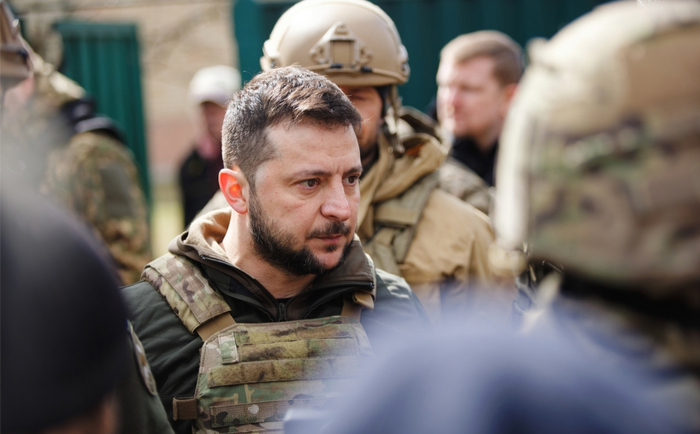
In conflicts and crises, people look to both political and business leaders for reassurance, competence and calmness under pressure.
-
May 18, 2022

Research suggests credit rating agencies perceive companies led by narcissistic chief executives as riskier propositions.
-
June 7, 2022
While being Machiavellian is generally seen as a negative characteristic, a study shows that it can offer important advantages for leaders.
-
March 8, 2022
John Rich is co-ordinating MHP's distribution drivers throughout the country: "If we fail the biggest distribution of food in Ukraine fails.”