

Could we be approaching a time when governance watchdogs decide how many big company audits any one audit firm can have? Certainly that was the impression after comments from one of the country’s leading regulators.
Discussion of an audit market share cap emerged last week after remarks made by Sir Jon Thompson, chief executive of the Financial Reporting Council. While speaking to members of the Institute of Chartered Accountants in England and Wales (ICAEW), Thompson said he had asked the government for powers that would enable the regulator to impose a market cap.
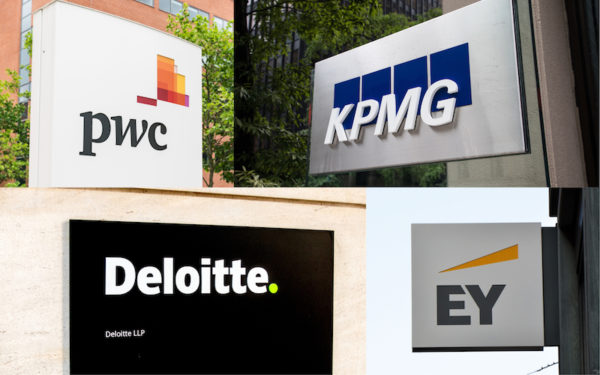
The idea is not a new one. There has been concerns for many years that the audits of big companies are concentrated in the hands of too few audit firms (the Big Four—PwC, EY, Deloitte and KPMG, though PwC holds the majority of FTSE 100 audits). In 2016 the European Union passed measures like mandatory audit rotation to tackle concentration but, though there has been some movement, the market remains much as it was.
A market cap, so far untried, remains a popular option in some quarters. Tim Bush, a governance expert with shareholder advisory firm Pirc, says: “If auditors were capped at 10% of the FTSE 100 market there would be ten auditors in the market, not four.”
Audit reform
A cap was discussed as part of the government’s audit reform white paper published earlier this year. The idea was rejected, with government preferring to opt for “managed shared audits” instead, while also suggesting a “reserve power” for the secretary of state to allow regulators to set a cap if a need arises. Sir Jon’s comment indicates he appears to have thrown his weight behind having such powers.
According to John Boulton, a policy expert with the ICAEW, there was little detail from Sir Jon’s remarks to understand how a cap might work in practice, but it suggested it might be used on a case-by-case basis rather than across the entire market in one go. That might entail opposition from the audit committee of any company involved who might suddenly find its audit “freedom of choice” curtailed and managing the market fallout. “You can imagine them having some objections,” says Boulton.
He warns therefore that a cap needs to be “applied carefully” and with “a strategy”. He also argues regulators might want to wait before intervening to see how the audit market develops because of signs that previous measures are working. Previous policies like mandatory rotation have suffered from being “over looked”, he says and more time might see them deliver a redistribution of audits to a wider group of providers. Far better those policies are given time to work and the market concentration adjusts itself “organically”. That, has got to be a “better outcome,” says Boulton.
Consequences of an audit cap
Elsewhere, there is outright opposition to a cap. Maggie McGhee, governance director with ACCA, says a cap would reduce choice and stymie an audit committee’s ability to pick an auditor based on quality. “The modern audit is highly complex, with auditors much more reliant on specialist knowledge—such as tax, pensions or valuation—than they were in the past.” Should a cap be introduced, she fears the possibility of a “higher risk company” being served by a “challenger firm”.
And she worries a cap could produce unintended consequences such as an increased focus on the regulatory supervision of audit committees and their members that might affect auditor selection. “So the risks are around complexity in the system, lack of transparency and restriction of choice,” says McGhee.
A department for business spokesperson would not be drawn on whether government will plump for a market cap while considering proposals in the white paper. “Our consultation on audit reform set out a wide range of proposals to restore trust in big business,” the spokesperson said. “We will respond to the consultation in due course. No decisions have been taken.”
However, that means all options remain on the table. For now. A cap may not be auditors’ favourite option, but it is entirely possible regulators will receive those powers all the same.
Related Posts
-
September 25, 2023
Shadow minister for business, Jonathan Reynolds, says Labour will push through audit reform when in office.
-
October 5, 2021

Transparency groups including Greenpeace UK say failing to disclose the audits involved "risks creating a general lack of confidence in all audit opinions".
-
November 26, 2021
While bemoaning the "glacial" pace of audit reform, he hails the pandemic's transformation of communication between boards and employees.
-
May 11, 2022
While the creation of ARGA is confirmed, details about other proposed changes are scant and uncertainty over timing remains.