Skip to content

7 September, 2026

  • Saved Articles
  • My Account
  • Subscribe
  • Log In
  • Log Out

Board Agenda

  • Governance
  • Strategy
  • Risk
  • Ethics
  • News
  • Insight
    • Categories

      • View all
      • Governance
      • Strategy
      • Risk
      • Ethics
      • Board expertise
      • Finance
      • Technology
    • data

      Every board needs a scientist or engineer

      STEM professionals are trained to work with incomplete data, and in business you rarely have...

      climate risk

      Now is the time to take action on climate risk

      Whatever direction national policies take, nature and climate remain as drivers of value and risk...

      AI risk

      AI is about strategy, not technology

      Clients are judging how professional services firms are performing against their AI expectations, but most...

  • Comment
      • View all
    • data

      Every board needs a scientist or engineer

      STEM professionals are trained to work with incomplete data, and in business you rarely have...

      climate risk

      Now is the time to take action on climate risk

      Whatever direction national policies take, nature and climate remain as drivers of value and risk...

      ai skills gap

      Don’t forget to price up the AI skills gapĀ 

      With AI set to be biggest force reshaping organisations, it is time to put workforce...

  • Interviews
      • View All Interviews
      • Podcasts
      • Webinars
    • governance

      How better governance helps private companies grow

      If governance is to become mature, management decision-making has no place on the board’s agenda,...

      future-ready

      Is your board ā€˜future-ready’?

      The survival of a business in uncertain times depends on its ability to pivot as...

      investor confidence

      Lack of audit reform ā€˜will hit investor confidence’

      Government's failure to push ahead with audit reform is a risk to UK investments, the...

  • Board Careers
      • View All
    • board skills clash

      When board skills clash

      Board composition in terms of expertise has a clear impact on entrepreneurial decision-making and strategy,...

      female ceos

      FTSE 100 CEO appointments rise

      The number of CEO appointments has doubled in six months, although the global picture suggests...

      board role

      How to engage with outreach

      When board opportunities knock, should you answer the door? Here are tips from a new...

  • Resource Centre
      • White Paper Downloads
      • Book Reviews
      • Board Advisory & Corporate Services
    • Georgeson 2026 European AGM Season Review

      Georgeson’s deep dive into theĀ evolving dynamics of investor voting across nine major European markets in...

      2026 MidYear Executive Benchmark Survey: The Verification Gap

      AI enthusiasm is running into reality: 1 in 4 executives in this Workiva survey say...

      Seven Steps for Futureproofing Business

      This guide from Business in the Community aims to help businesses build a practical strategy...

  • Events
  • Search by topic
    • Governance
    • Strategy
    • Risk
    • Ethics
    • Regulation
    • ESG
    • Investor Relations
    • Careers
    • Board Expertise
    • finance
    • Technology

Public confidence in ethical business behaviour falters

by Gavin Hinks on December 20, 2019

A new survey reveals 57% of the British public believe business behaves ethically, down from a record high of 62% last year.

Public trust in ethical business behaviour

Image: Willy Barton/Shutterstock.com

Favorite

The reputation of business for ethical behaviour is sometimes not what it should be—and new research reveals that public expectations have fallen.

A survey by the Institute of Business Ethics (IBE) finds that 57% of the British public believe business behaves ethically compared with last year’s 62%, which was the highest level of confidence in business behaviour since the survey was launched in 2003.

It seems that executive pay and tax avoidance are major factors in reducing public confidence in business ethics. And in the year in which Greta Thunberg became Time magazine’s person of the year, so too has the environment.

According to the IBE’s director Philippa Foster Back, an underlying issue in the survey is a loss of confidence in business behaviour among younger generations. Business, she said, is not doing enough on some of its core issues and it needs to ask why.

ā€œWhat we are seeing is that it is younger people who are losing confidence in business operating ethically,ā€ said Foster Back. ā€œIn previous years, a smaller proportion of young people—compared with other age groups—perceived business to behave unethically. This year, those figures have levelled out, which business needs to address.ā€

Public pessimism comes despite success for business in others areas such as discrimination in the workplace and disclosure of information. But Foster Back said there is more to do.

ā€œThe fact that corporate tax avoidance, executive pay, and environmental responsibility remain top of the list—and the latter two at increased proportions—indicates that business is not doing nearly enough to address the ethical issues that the public are most concerned about,ā€ she said.

Renewed focus

The top three areas of concern remain the same as last year, though their significance has changed. Of those surveyed, 33% said tax avoidance was a worry (the same as last year); executive pay was an issue for 29%, up five percentage points on 2018; and 28% focused on the environment, up four percentage points.

This has been a year in which campaigners have brought renewed focus on the environment through the action of groups such as Extinction Rebellion, while Greta Thunberg has grabbed front-page headlines visiting UN conferences in the US and Europe. Her own actions have inspired millions of children to strike from school on Fridays.

Tax avoidance, meanwhile, has received much attention not least because of a continuing debate over profit shifting in relation to big digital companies such as Facebook, Google and Amazon.

In the UK, investors have continued to ensure executive pay remains an issue of concern through their engagement and voting policies.

Lower down the pecking order of concerns comes exploitative labour policies, noted by 18% as an issue. 2019 saw the first divestment of an asset owner from a stock because of labour exploitation concerns when in November Norges Bank gave up its shares in G4S over the treatment of workers in Qatar and United Arab Emirates.

Diana Eltahawy, head of the migrants programme in the Gulf for the Business and Human Rights Resource Centre, said at the time that the decision was ā€œmonumentalā€. She added: ā€œHuman rights are just as important as climate. Companies really need to assess all their risks.ā€

Long-term risks

On pay, companies face calls to shrink the gap between low and high earners and pay their taxes. According to Luke Hildyard, director of campaign group the High Pay Centre, the IBE research provides ā€œpowerful findingsā€ that should prompt concern among businesses leaders about the long-term risks they face.

ā€œA society riven with divides between those at the top and everybody else, with added environment instability thrown into the mix, is unlikely to be socially or economically successful,ā€ he warned.

Nada Kakabadse, professor of policy, governance and ethics at Henley Business School, said trust in business, public institutions, government, the media and even NGOs has been ā€œsteadily decliningā€ since the 2008 financial crisis. She too highlighted the low opinion of Millennials regarding business behaviour, but also noted gender differences. Women, as ā€œcare giversā€ or ā€œcare receiversā€ regard relationships as more significant, along with environmental responsibility. Men tend to focus on issues such as tax avoidance, she said.

She added that the importance of trust remains a hot topic, especially ā€œthe consequences of when this is underminedā€.

ā€œSince the global financial crisis of 2008 people’s trust in public institutions, businesses, government, media and NGOs has been steadily declining,ā€ said Kakabadse.

ā€œAdd to this environmental damage, pay discrimination, a lack of effective government regulation and responsiveness, decreases in quality work opportunities and, of course, people’s personal experiences, and it is completely understandable how businesses’ values and ethics are misaligned with those held by the general public.ā€

  • Facebook
  • Twitter
  • Google+
  • LinkedIn
  • Mail

Related Posts

  • Annual survey reveals 42% of the public consider business 'unethical'
    January 18, 2022
    Employees commuting to work

    The Institute of Business Ethics says just 40% of those polled in its annual survey think business is ethical—down from 59% in 2020.

  • Ethics in the technology sector remains a headline issue
    January 26, 2022
    Businessman has biometric data scanned

    For a second year running technology is the sector that garnered the most news stories about ethical lapses—with data privacy a key concern.

  • Corporate ethics fail to win people’s confidence
    July 14, 2023
    corporate ethics

    Public trust in UK businesses is six points down on last year, research by the Institute of Business Ethics finds.

  • Investment managers hesitant to embrace ethics as part of ESG
    March 21, 2022
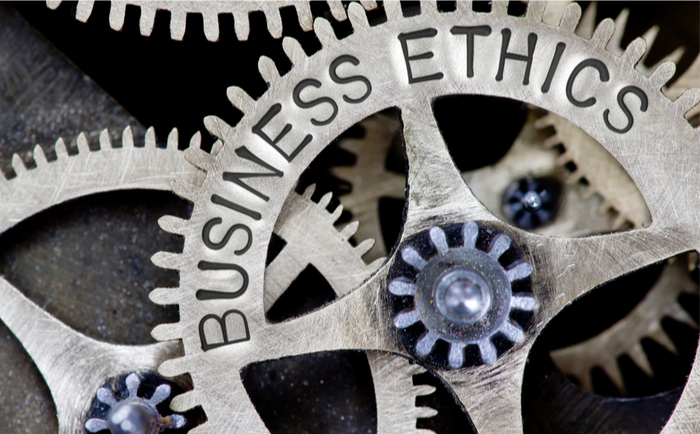
    Business ethics on cogs

    Study finds investors shy away from direct talk of ethics, but some are assessing company culture as an indicator of ESG performance.

Search


Follow Us

Most Popular

Featured Resources

The Future of FTSE 350 Chairs: Pathways, Pipelines & Barriers 2026

This report is a collaboration between the FTSE Women Leaders Review and Professor...

Agentic AI from principles to practiceĀ 

ā€˜A C-suite guide to capturing value without losing control’, this Forvis Mazars...

Route to the Top: Europe 2026Ā 

This survey report from Heidrick & Struggles finds that companies are tending...
board's role in a rewired world fgs 2026 cover

A hard job getting harder: The board's role in a rewired world

The role of a corporate director is demanding intellectually, ethically and strategically—and...

Boardroom resilience: Practical governance for risk, readiness and rapid response

Boards are operating in a world defined by uncertainty. Geopolitical tensions, climate...

Board Value Index Summer 2026

Board Intelligence found 86% of directors say rigid processes and inconsistent frameworks...

Governance Guide: Navigating Conflict in the Boardroom

The 'Governance Guide' on navigating conflict in the boardroom provides practical...

Becoming a non-executive director (4th edition)

Board composition is the subject of much debate, while the role of the non-executive...

SUBSCRIBE TODAY

Stay current with a wide-ranging source of governance news and intelligence and apply the latest thinking to your boardroom challenges. Subscribe


  • Editors & Contributors
  • Editorial Advisory Board
  • Board Advisory & Corporate Services
  • Media Marketing Solutions
  • Contact Us
  • About Us
  • Board Director Network
  • Terms & Conditions
  • Privacy Policy
  • Cookies

Copyright Ā© 2026 Questor Media Group Ltd.

  • Terms & Conditions
  • Privacy Policy